
A preventive maintenance checklist tells a team what to look at. An asset plan connects those checks to identifiable equipment, approved tasks, due dates and accountable people. For facility managers and building owners in Saudi Arabia, that connection makes it easier to see what has been inspected, what remains outstanding and whether a reported defect has actually been resolved.
Start with the building’s operating needs, then create an asset inventory and a controlled task register. Use equipment-specific instructions and applicable approved requirements to establish the work. This guide explains that building-level approach, including an illustrative register. It supports planning and review; qualified specialists must determine technical procedures, acceptance criteria and any safety-critical decisions.
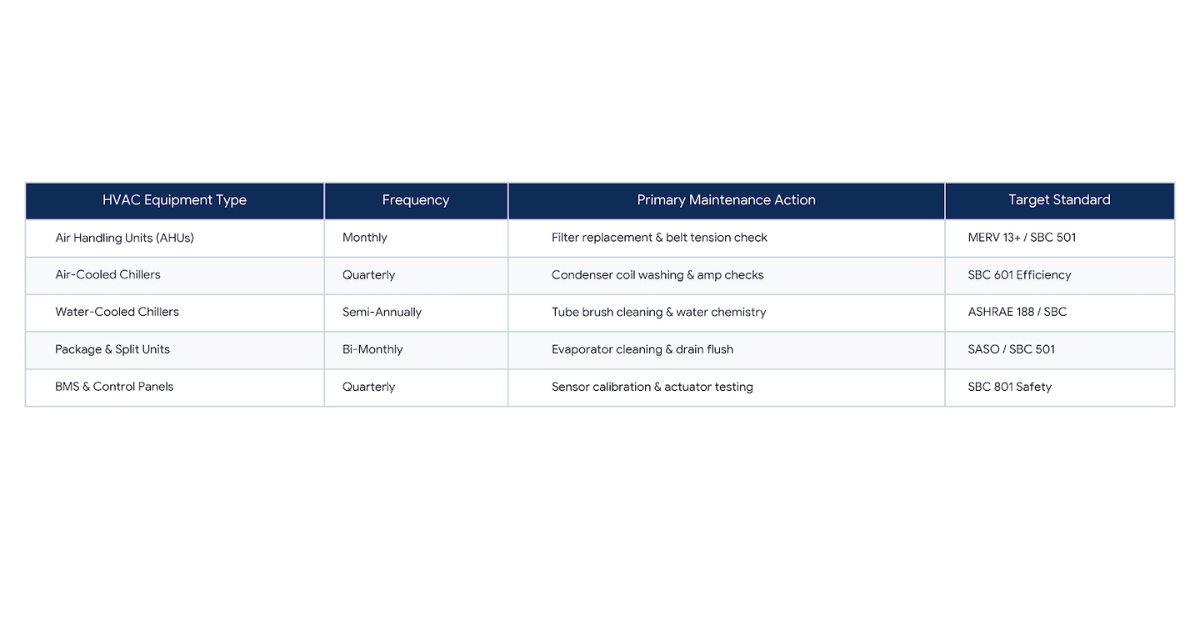
Start With The Building’s Operating Priorities
Identify Service Dependencies
List the services the building needs to operate: cooling, ventilation, power, water, drainage, lighting, access and relevant safety systems. Include building fabric and common areas rather than focusing only on large mechanical equipment. A drainage defect above an occupied room may deserve more attention than its small repair cost suggests.
Map which assets support each service and which occupancies depend on them. Record operating hours, tenant restrictions and available shutdown windows. An office, retail property and continuously occupied facility may need different arrangements for the same type of equipment. Confirm the actual site conditions instead of importing another building’s plan.
EXPRO’s National Manual of Assets and Facilities Management brings together asset management, maintenance, work control and related disciplines for Saudi government entities. It provides useful local context, but its government scope should not be presented as a universal obligation for every private commercial building.
Assess Operational Criticality
Ask what happens if an asset becomes unavailable. Consider affected services, duration of interruption, available backup and recovery arrangements. Separate operational inconvenience from consequences requiring specialist safety assessment. Criticality should explain a decision, rather than simply assigning every major item a high rating.
For example, two pumps may look identical while serving different functions. Confirm whether either provides backup and whether that backup is usable before relying on it. Record the reasoning and reviewer beside the classification. Reassess criticality when tenancy, operating hours or system configuration changes; an old rating may no longer describe the building’s needs.
Build A Reliable Asset Inventory
Identify Each Asset And Its Location

Give maintainable assets a consistent identifier. Record their physical location, system, manufacturer, model and serial number where available. Link the identifier to relevant drawings, manuals, commissioning information and service history. For building fabric, use a defined location or component reference that allows different people to find the same item.
Verify records against the installed equipment. A drawing may show a unit that has been replaced, and a service report may use a contractor’s informal name. Resolve these differences before scheduling work. Keep a history when equipment changes so previous defects are not mistakenly attributed to the replacement.
Flag Missing Records
Identify missing manuals, unclear ownership, inaccessible labels and assets without a confirmed maintenance basis. Assign someone to resolve each gap. Do not fill an unknown model or task frequency with a convenient guess. A provisional inventory can support discovery, provided its uncertainties remain visible.
The Ministry of Human Resources and Social Development’s asset and facilities management overview describes recording and assessing assets within a government management approach spanning their life cycle. For a commercial owner, the practical lesson is to connect records with operating decisions. This is an editorial recommendation, not a claim that the Ministry’s programme applies to all private buildings.
Create An Asset And Task Register
Use one record per asset/task combination. A single asset may need several tasks with different requirements, due dates and responsible roles. Keep the underlying asset inventory separate so model and location information remain consistent across those task records.
The following register is hypothetical. Asset IDs, locations and dates are examples for a fictional commercial building. They are not Silver Foundation project records, maintenance intervals or approved specifications. Operational criticality is illustrative and requires site assessment. References describe documents the real team must obtain and approve.
| Asset ID | Location | Operational Criticality | Task | OEM Or Approved Requirement | Due Date | Responsible Role | Defect Closure |
|---|---|---|---|---|---|---|---|
| AHU-01 | Roof plant room | High if occupied-zone cooling has no usable backup | Review condition and complete authorised service checklist | Applicable OEM manual and approved HVAC task sheet | 18 Oct 2026 example | HVAC specialist; FM coordinates access | Defect D-01 remains open pending correction and specialist verification |
| WP-02 | Basement pump room | High if loss interrupts the served water supply | Complete approved pump maintenance assessment | Applicable OEM instructions and approved pump task sheet | 20 Oct 2026 example | Mechanical specialist | Link work order, findings and accepted verification record |
| EL-03 | Level 2 electrical room | Confirm from supplied circuits and recovery arrangements | Arrange the authorised electrical inspection | Approved electrical procedure and applicable equipment instructions | 22 Oct 2026 example | Qualified electrical specialist | Close only after required corrective evidence and review |
| RF-04 | Roof drainage zone A | Site-assessed priority based on leak exposure | Assess visible drainage and fabric condition through authorised access | Approved roof inspection plan and relevant product instructions | 24 Oct 2026 example | Building-fabric specialist | Record location, correction evidence and reviewer acceptance |
Read the columns together. The task describes the authorised work; the requirement identifies its basis; the due date makes it schedulable; the responsible role identifies delivery. Defect closure tracks unresolved findings separately from completion of the planned visit.
In a live register, add the requirement’s document number and revision, last completion date, work-order link and evidence location. Assign a named person against each responsible role. Where one team performs work and another accepts it, record both functions.
Define statuses such as planned, in progress, completed with defect open and verified closed. Avoid a single green tick that hides outstanding corrective work. An inspection completed on time can still reveal a serious unresolved issue. Keep that distinction visible in the owner’s reporting.
Set Tasks And Due Dates From Approved Requirements
Use The Equipment’s Actual Maintenance Basis
The original equipment manufacturer, or OEM, provides instructions relevant to its equipment. Confirm the correct model and document revision. The facilities team and appointed specialists should also identify applicable approved site procedures, inspection obligations and operating restrictions. Record how any differing requirements are resolved through the appropriate approval route.
Use the separate HVAC maintenance checklist for Saudi commercial buildings for equipment-level topic coverage. This asset plan focuses on assigning, scheduling and evidencing work across the building. Generic checklist wording should still be checked against the installed system and its approved maintenance requirements.
Make The Schedule Deliverable
Set due dates from the approved task basis and the actual completion history. Some requirements depend on elapsed time; others may depend on operating hours or specified conditions. Do not apply one monthly or annual frequency to all assets. Specialists should assess how use and environmental exposure affect the approved plan.
Coordinate access, shutdowns, tenant notifications, specialist availability and necessary materials before the visit. Record tasks that cannot proceed because prerequisites are missing. A postponed task should retain its original due date, reason and escalation record rather than disappearing into a revised calendar.
Where a change to timing is proposed, obtain the necessary technical and operational review. Keep the original requirement and approval history. Convenience alone should not become the basis for extending a maintenance interval, particularly where statutory or safety-critical requirements may apply.
Turn Inspection Findings Into Closed Defects
Separate Task Completion From Resolution
An inspection report is evidence that a check occurred. It may also create corrective work. Give each defect a reference linked to the asset, location and work order. Record the finding, operational effect, responsible person, target date and any specialist-directed interim arrangements.
Hypothetical example: the HVAC specialist completes AHU-01’s approved inspection and identifies a drainage problem. The planned inspection is recorded as completed, while defect D-01 remains open. The facilities manager coordinates the authorised corrective work and its verification. The defect closes only when the agreed evidence is accepted; attendance alone does not close it.
Agree What Closure Evidence Must Show

Ask the relevant specialist to define suitable verification. Depending on the task, evidence may include an inspection record, agreed test results, replacement details or a service report identifying the corrected condition. Photographs can support a record, but they do not automatically demonstrate functional performance.
Record the reviewer, decision date and any acceptance conditions. Distinguish temporary restoration from a permanent correction. If a defect recurs, link the new finding to the earlier record and request assessment of the cause. Repeatedly issuing the same work order can conceal an unresolved equipment or operating problem.
Electrical, refrigerant, lifting, access-at-height and safety-system work require appropriate competence and authorised procedures. This article does not prescribe how to perform them. Use the building’s approved escalation arrangements when a finding affects safety or essential operations, rather than waiting for the next planned reporting cycle.
Review The Plan Across The Building
Review overdue tasks alongside their criticality and reasons for delay. Check whether open defects lack an owner, verification requirement or achievable access window. Look for recurring faults and incomplete records. These reviews help managers decide where specialist investigation, resources or revised operating arrangements are needed.
Measure completion and closure separately. A high percentage of completed visits may coexist with unresolved defects. For energy or reliability comparisons, consider occupancy, weather, operating hours and system changes. Avoid attributing every improvement to maintenance or promising a fixed saving without an appropriate assessment.
Keep the asset plan distinct from contract scope. The plan states what the building needs; the agreement determines who delivers which services and under what terms. Refer to the related HVAC and plumbing maintenance-plan guide for service-plan considerations. Confirm coverage and exclusions for the actual appointment rather than assuming every asset is included.
Update the register when assets are replaced, tenants change or new defects alter priorities. Preserve previous records and identify who approved the revision. A plan remains useful when it reflects the installed building and current responsibilities, not simply when its checklist has been copied into another year.
Discuss Your Maintenance Requirements With Silver Foundation
Silver Foundation’s maintenance services describe HVAC inspection, regular maintenance, repair, installation and replacement. Share your asset list, record gaps and operational restrictions through the contact form. Ask the proposed team to confirm included systems, specialist responsibilities and reporting evidence. Confirm other disciplines and capabilities separately before appointment.
Conclusion
Preventive maintenance is an investment that protects equipment, occupants, and daily operations. Regular inspections, documented schedules, and timely servicing help prevent costly issues. Silver Foundation can support Saudi commercial properties with reliable specialist maintenance when needed.
Frequently Asked Questions
Can An Asset Plan Begin With Incomplete Equipment Records?
Yes. Begin with a verified inventory of what can be identified, then mark missing information explicitly. Assign someone to obtain manuals, confirm models and resolve ownership. Keep provisional records separate from approved technical tasks. Avoid inventing maintenance frequencies to fill gaps; the relevant specialist should establish an acceptable basis before the work is scheduled.
Who Should Approve Maintenance Frequencies?
The facility manager should coordinate review with the relevant qualified specialist using applicable OEM instructions, approved procedures and any governing requirements. The owner confirms operational arrangements and resources within the agreed responsibilities. Record the source, revision and decision. A contractor’s standard visit schedule alone may not match every asset’s approved maintenance needs.
Does A Completed Inspection Mean A Defect Is Closed?
No. An inspection can be completed while the defect it identifies remains open. Link the finding to a corrective work order, assign an owner and agree the verification evidence. Closure follows acceptance of that evidence by the authorised reviewer. A visit log, invoice or photograph alone may not demonstrate that the required correction has been achieved.
How Should Overdue Critical Tasks Be Handled?
Keep the original due date visible and record why the task is overdue. Escalate through the building’s approved technical and operational arrangements. The relevant specialist should assess implications and any necessary interim actions. Arrange the missing access, resources or approvals, and document authorised changes. Simply moving the calendar date does not resolve the underlying requirement.
Can A Spreadsheet Support An Asset Plan?
Yes, provided identifiers, responsibilities, due dates, requirement references and evidence links are controlled. Protect the master version and define who can update it. Maintain a change history and review outstanding tasks and defects. Larger portfolios may benefit from maintenance-management software, but software does not replace verified asset information, approved tasks or accountable review.