
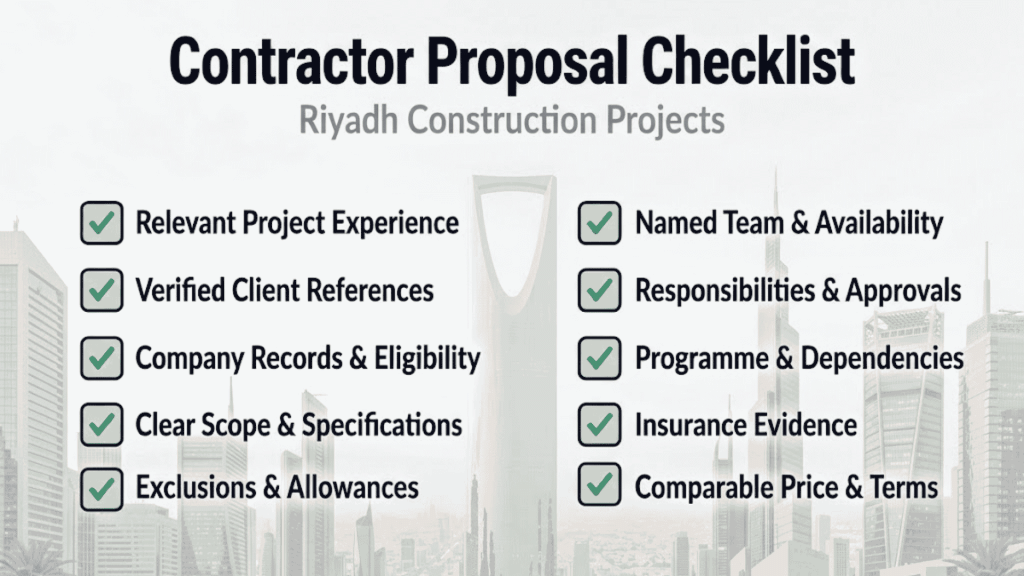
Choosing a construction contractor in Riyadh starts with comparing evidence against your project requirements. Request relevant project records, a defined scope, explicit exclusions, named responsibilities, a realistic programme, insurance documents and contactable references. Then assess every proposal against the same buyer-set criteria.
For project owners and procurement teams, the useful question is whether a bidder can explain and support how it will deliver this particular project. A licence, registration or attractive portfolio answers only part of that question. It does not establish the quality of future workmanship or guarantee completion.
This guide provides a proposal evidence checklist and a comparison method you can adapt before inviting bids. Use it for construction packages in Riyadh, with requirements adjusted to the building type, procurement route and site conditions
Give Every Bidder The Same Project Brief
Prepare one controlled enquiry package. State the project location, intended use, scope boundaries, drawing revisions, specifications and required completion milestones. Explain whether you are seeking construction only or a wider package that includes design, fit-out or mechanical, electrical and plumbing services, commonly called MEP.
Include known constraints: occupied areas, access windows, landlord requirements, storage limits, shutdown permissions and interfaces with other contractors. Ask bidders to identify anything they could not verify during their site visit. A qualification should be visible before award, rather than appearing as an unexpected assumption during delivery.
Give all bidders the same response template and clarification deadline. Share material answers with everyone through a numbered enquiry amendment. Keep a record of which revision each bidder priced. If the drawings are incomplete, identify the unresolved design items and request separately stated allowances instead of pretending the price is fully defined.
Related Resource: Office Renovation in Riyadh

Request Evidence Of Relevant Projects
Ask for two or three projects with a useful connection to your scope. Similarity may mean building use, construction method, size, live-site conditions or MEP complexity. A visually impressive project in another sector may provide less relevant evidence than a modest project with matching constraints.
For each example, request the location, completion date, approximate scope, contractor role and a reference contact whose details can be shared with permission. Establish whether the bidder was the main contractor, a specialist subcontractor or a design provider. Do not attribute the whole project to a firm that delivered one package.
Ask for supporting records that can reasonably be disclosed, such as redacted completion documents, approved material submissions, inspection records or a handover index. Treat marketing photographs as supporting context. They rarely explain hidden work, contractual performance or how defects were resolved.
Speak to references using the same questions. What work did the contractor actually deliver? Were changes priced and agreed before execution? Were reports useful? How were delays explained? What remained outstanding at handover, and how was it addressed? Record the caller, date and factual response rather than a general impression.
Keep verified reference observations separate from bidder claims. If a contact is unavailable, record the gap and seek another comparable reference; do not silently mark it as confirmed.
Check Company Records And Project Eligibility
Match the bidding entity to the name on the proposed contract, company documents and payment details. Ask your procurement or legal reviewer to confirm the records and permissions applicable to the proposed work. Avoid treating one generic certificate as evidence that every activity or project is covered.
Muqawil, operated by the Saudi Contractors Authority, provides a directory for finding registered contractors by characteristics such as specialisation, size and location. Use it as a source for checking contractor information, alongside the records supplied by the bidder.
Where classification is relevant to your procurement, Balady publishes guidance for searching classified establishments using identifying information and filters including field, city, grade and certificate expiry. Have the applicable classification requirements checked for your specific project; this guide does not assert that every private construction package has identical requirements.
Registration and classification checks serve a different purpose from assessing proposed workmanship, staff availability and delivery controls. Evaluate those through project-specific evidence as well.
Make Scope And Exclusions Explicit
Request a priced scope organised by work package. A bill of quantities, or BOQ, lists work items and quantities, but it should still be read with the drawings, specifications and proposal qualifications. Ask bidders to explain discrepancies rather than assuming all documents describe the same work.
For every package, establish whether the offer includes supply, installation, coordination, testing and handover. Identify material specifications and any proposed alternatives. Separate firm prices from provisional sums, which are allowances for work that is not yet fully defined. Also state how quantities will be measured if the pricing basis permits remeasurement.
Read the exclusions as carefully as the total. Examples to clarify include demolition, waste removal, temporary services, utility connections, authority fees, third-party testing, owner-supplied items, final cleaning and operating manuals. These are questions to resolve, not a universal list of items every contractor must include.
Ask for a complete exclusion schedule, even when the response is “none”. Require each qualification to reference the affected work item. Confirm whether the price includes applicable tax, the offer validity period and the basis for any adjustment. Do not compare one tax-inclusive offer with another that excludes tax.
For example, “HVAC included” is insufficient if one bidder includes equipment, controls and testing while another prices installation only. Resolve that difference through a written scope clarification before ranking the prices.
| Evidence Area | Request | Buyer Verification |
|---|---|---|
| Relevant Projects | Comparable examples and permitted references | Actual role, matching scope and reference response |
| Company Records | Entity details and applicable documents | Identity, validity and project applicability |
| Scope and Materials | Priced packages and specification references | Drawing revision, supply and installation boundaries |
| Exclusions and Allowances | Separate schedules with item references | Missing work, uncertain quantities and price basis |
| Delivery Team | Named roles, availability and subcontractor plan | Proposed resources for this project |
| Programme | Milestones and dependencies | Approvals, procurement and site access assumptions |
| Insurance | Schedule, relevant wording and endorsements | Qualified review of parties, activities and gaps |
| Completion | Inspection and handover deliverables | Acceptance criteria and outstanding-work process |
Ask who prepares, submits, reviews and approves each deliverable. A proposal should distinguish doing the work from accepting it. The owner’s representative, consultant, contractor, landlord and specialist suppliers may each have different tasks.
Record interfaces explicitly. Who obtains required owner information? Who prepares shop drawings? Who coordinates MEP with structure and finishes? Who arranges inspections and supplies testing records? If another contractor supplies an item, identify who receives it, installs it and checks the interface.
Agree who initiates and approves changes, and how the cost and programme effects will be recorded. A proposal is not a substitute for reviewed contract terms. Carry the agreed responsibility schedule and clarifications into the contract documents through the appropriate review process.
| Task | Proposed Responsible Party | Review Or Approval Party | Open Clarification |
|---|---|---|---|
| Design and Drawing Coordination | To be agreed | To be agreed | Deliverables and design boundaries |
| Permits and Submissions | To be agreed | To be agreed | Who submits, pays and provides inputs |
| Materials and Substitutions | To be agreed | To be agreed | Approval route before ordering |
| Interfaces with Other Trades | To be agreed | To be agreed | Connection and testing boundaries |
| Changes and Additional Work | To be agreed | To be agreed | Written authorisation process |
| Testing and Handover | To be agreed | To be agreed | Acceptance records and manuals |
For a wider delivery arrangement, define the actual contracted scope even if the proposal uses the word “turnkey”. The label alone does not settle exclusions or transfer every responsibility.
Read the guide to turnkey construction projects for the delivery model.
Review Delivery Plans And Insurance Evidence
Request a programme that shows mobilisation, drawing approvals, material submissions, procurement, construction, testing and handover. Ask which activities depend on your decisions or third parties. A completion date without these dependencies gives the buyer little basis for assessing feasibility.
Check the named project manager and site team, including availability and planned supervision. Request a subcontractor strategy for specialist work. Ask how inspections, material approvals, non-conforming work and corrective actions will be recorded. Sample reporting formats can show how the contractor proposes to communicate, without implying that a template proves past performance.
For specialist building systems, see the MEP contractor selection guide.
Request insurance evidence suitable for review against the proposed work. Have a qualified insurance adviser check the insured entity, project or activity description, period, limits, deductibles, exclusions and relevant endorsements. Confirm what evidence will be needed before mobilisation and how renewal will be monitored if the works extend beyond the policy period.
The appropriate cover depends on the scope, risks and contractual requirements. Do not assume a certificate summary confirms every loss is covered or that the owner has no residual exposure. Record unresolved questions and obtain professional review before accepting the proposed insurance arrangements.
Use A Buyer Set Proposal Comparison
Set the comparison rules before evaluating bids. First identify mandatory requirements: the scope that must be accepted, required documents, delivery constraints and any project-specific conditions. Use Pass, Fail or Pending, with an evidence reference. Define whether a pending item prevents award and the date by which it must be resolved.
Next choose weighted preferences that reflect your project. Possible criteria include comparable experience, scope completeness, delivery resources, programme credibility, quality controls and commercial terms. Set the weights yourself so they total 100 percent. There is no universal weighting suitable for every Riyadh construction project.
One optional rating scale is 0 to 5: 0 means no assessable evidence; 1 means major gaps; 2 means partial support; 3 means the stated requirement is supported; 4 means supported additional value; and 5 means strongly evidenced value relevant to the buyer. Define what each score means for each criterion before scoring. Keep a Pending flag beside unresolved claims rather than allowing a numerical score to imply verification.
Calculate each weighted contribution as the criterion weight multiplied by the score divided by 5. Add the contributions for a total out of 100. The highest score supports a recommendation; it does not automatically determine the award. If a mandatory requirement fails, follow the procurement rules set for that requirement rather than letting a high preference score compensate for it.
| Buyer Set Criterion | Weight % | Bidder A Score | Bidder B Score | Bidder C Score |
|---|---|---|---|---|
| Relevant Project Evidence | Set | — | — | — |
| Scope Completeness | Set | — | — | — |
| Team and Programme | Set | — | — | — |
| Quality and Handover Controls | Set | — | — | — |
| Comparable Price and Terms | Set | — | — | — |
| Total Weighted Result | 100 | — / 100 | — / 100 | — / 100 |
For every rating, attach a record containing the bidder name, criterion, evidence document and page, verification status, reviewer and reason for the score. The blank matrix above is a summary; it is not a substitute for that evidence record.
Compare prices on the same confirmed scope. Show the submitted price, bidder-confirmed additions or deductions for scope alignment, and the resulting comparison price on a consistent tax basis. Keep unpriced exclusions and uncertain allowances visible. Do not invent an adjustment to make an incomplete bid appear comparable. The comparison price is an evaluation tool, not an agreed contract amount.
Close Clarifications And Record The Decision
Send each bidder a numbered list of outstanding questions. Request answers that identify the affected document and revision, along with any change to price or completion dates. Consolidate the response into a final proposal rather than relying on scattered messages.
| Item And Bidder | Question And Evidence Needed | Owner And Deadline | Award Blocking Status |
|---|---|---|---|
| Reference Check | Confirm actual scope and provide a permitted contact | Assign / date | Buyer to decide |
| Excluded Work | Confirm inclusion and revised price | Assign / date | Buyer to decide |
| Insurance Review | Resolve adviser questions with policy evidence | Assign / date | Buyer to decide |
| Programme Dependency | Confirm approval date and effect on completion | Assign / date | Buyer to decide |
Record why the preferred proposal best meets the agreed requirements, including remaining risks and their owners. A low price can be competitive when its scope and delivery basis are supported; a higher price does not prove better quality. Seek the required technical, procurement and commercial approvals, then incorporate the agreed scope, exclusions and responsibility records into the contract review.
If your package is primarily interiors, consult the fit-out contractor selection guide.
Discuss Your Project With Silver Foundation
Silver Foundation lists construction services including civil works and project management. When requesting a proposal, share your drawings, required scope, site constraints and target milestones. Ask for project-relevant evidence and explicit exclusions so you can apply the same comparison process to its offer.
Frequently Asked Questions
What If A Contractor Cannot Disclose A Previous Client?
Ask whether a reference can be shared with permission or whether redacted project records are available. Confidentiality can limit disclosure, so assess the explanation and alternative evidence. Record any remaining verification gap. Apply the same evidence standard to all bidders and use your pre-agreed procurement rules when deciding whether the gap prevents shortlisting or award.
How Should Buyers Compare Different Exclusions?
List each exclusion against the common scope and request a bidder-confirmed price for including the required work. Compare the revised offers on a consistent basis. Where an exclusion remains unpriced, show it as an unresolved exposure rather than assigning a guessed cost. Also check whether bringing the work into scope changes the proposed programme or responsibilities.
Can A Smaller Contractor Remain On The Shortlist?
Company size alone should not decide suitability. Assess comparable work, available supervision, specialist support and the resources committed to your project. A smaller bidder may remain suitable where it meets the mandatory requirements and supports its delivery plan. Record any capacity concerns and seek evidence before accepting assurances about staff or subcontractor availability.
What Should Happen When Insurance Documents Are Pending?
Mark the requirement Pending and request the missing evidence by a defined deadline. Have the appropriate adviser assess the documents against the project and proposed contract. Your procurement and contract reviewers should decide whether that gap blocks award or mobilisation. Do not describe proposed cover as confirmed while relevant policy details or endorsements remain unresolved.