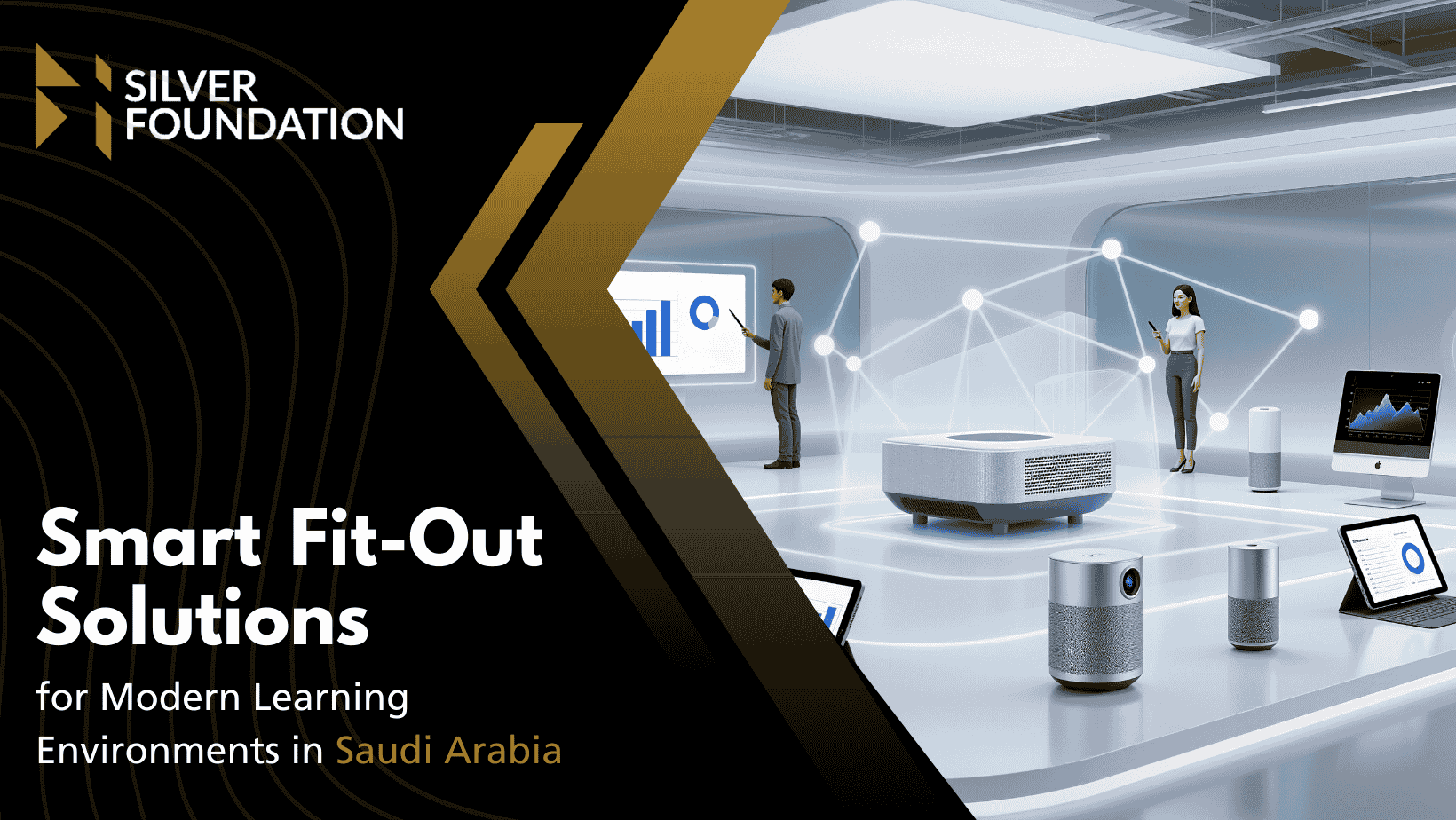
Saudi Arabia’s education sector is rapidly evolving under Vision 2030, driving the need for modern, innovative learning spaces. Schools, colleges, and universities are investing in state-of-the-art facilities that inspire students and empower teachers. Smart fit-out solutions are at the heart of this transformation, blending technology, ergonomic design, and flexibility to create engaging environments. Silver Foundation introduces the latest trends and practical applications of cutting-edge fit-out solutions shaping the future of education in the Kingdom. Let’s discuss them all in detail below.
Today’s learning environments are flexible, collaborative and student-centred, using modern technology to facilitate active learning. These areas are defining themselves as a modern lecture hall, providing areas of group work, discussions and silent study. They also follow modern integration of learning and completely online classrooms, where students can learn at any time and place. Energy-efficient and sustainable designs are being favoured increasingly for being less harmful to the environment and more comfortable.
Research indicates that classrooms furnished with some ergonomic furniture, sufficient lighting and attractive visual arrangement have a positive impact on the level of student engagement. It also helps with better concentration and academic performance. Modern learning environments can be characterized by comfort, flexibility, and technology, establishing environments in which students and teachers may excel.
Core Components of Smart Fit-Out Solutions
Furniture Solutions
Posture and comfort are enhanced by ergonomic chairs, adjustable desks, and working together tables. Furniture that is well-designed enables active learning, whereby the students can easily alternate between individual tasks and group work. The right furniture promotes interaction, prevents boredom, and provides an atmosphere of welcome. It also promotes attention, cooperation, and innovation during school days.
Technology Integration
Interactive whiteboards, smart screens, and VR/AR tools help enhance the process of teaching and learning. Technology gives us practical classes, online learning and convenient access to world resources. Instructors can monitor the progress of students, modify content and promote creative problem solving. Integrated technology changes the old classrooms into exciting teaching and learning environments.
Lighting and Acoustics
This is done through natural lighting, LED smart lights and soundproofing to generate productive classrooms. Lightly illuminated rooms cause less eye overload, and appropriate acoustics cause fewer distractions. Sound and lighting design can help to create comfort and focus, as well as the well-being of the students. They improve the learning environment and make classrooms welcoming and exciting to both students and teachers.
Modular Design and Flexibility
Reconfigurable classrooms with movable walls enable spaces to be used for different activities. It is easy to switch from the lecture to group work and presentation in classrooms. The modular design will allow the fullest use of space and facilitate various methods of teaching. Thus, the modular arrangements promote learning, innovation and teamwork and make the classroom preserve functionality, comfort, and aesthetics.
Significant Benefits of Smart Fit-Out Solutions
Premium Space Occupancy
Smart fit-out optimizes the use of the available space to make sure that every corner has its purpose. Modular designs, flexible layouts and progressive storage features minimize the wastage of spaces, which creates workable working environments. This effective use encourages a superior workflow, higher occupancy rate and future expansion without expensive structural modification.
Enhanced Productivity of the Employees
Smart fit-outs increase worker comfort and productivity by introducing ergonomic furniture, smart designs, and work areas. Lighting, organization, and technology can reduce fatigue and distraction to produce creativity and concentration. The outcome is improvement of morale, increased productivity and a good culture in the workplace, which is suitable for both the workers and the organizations.
Sustainability and Cost Planning
Smart fit-out systems tend to employ efficient energy-related materials, modular, and green design principles. This reduces the building and renovation costs, decreases the energy usage, and the operational costs. The long-term savings are coupled with environmental responsibility. This makes smart fit-outs economical and ecologically beneficial to business ventures that strive towards sustainable development.
Flexibility and Scalability
The contemporary smart fit-outs are set to be able to accommodate the evolving needs of the business. Quick reconfigurability of spaces is made possible by modular partitions, movable furniture, and tech-enabled workstations. It has the benefit of allowing an organization to expand or reorganize its teams or adjust its operational needs as needed. Thus, it ensures that the workspace is ready to meet future requirements.
Enhanced Aesthetics and Brand Image
The smart fit-outs are designed using modern design, out-of-the-box materials and modern technology. An office that has been effectively designed shows the values and professionalism of a company and pleases clients, and brings talent. Functionality and beauty merge to ensure that the business builds a solid brand and creates a friendly and motivational atmosphere for both employees and visitors.
Saudi Arabia is Embracing Modern Fit-Out Solutions
Saudi Arabia is in the process of making significant investments in the field of modern learning environments to facilitate the education reform and Vision 2030 objectives. The government programs are the improvement of the school infrastructure, modernization of higher education institutions, and the use of technology in classrooms. Private schools and international universities are also embracing smart fit-out solutions to enhance the learning experiences.
Startups in EdTech are also contributing significantly by providing interactive teaching digital tools. Design is affected by regional and cultural aspects such as gender-separated classrooms, climate-responsive technologies in lighting, cooling systems, and materials. Saudi Arabia is designing educational environments that are inclusive and efficient to accommodate all students.
Introducing Latest Trends in Smart Learning Environments
Online Courses and E-learning
Learning experiences are being altered by AI-based analytics, VR/AR applications, and interactive content. The classrooms available digitally provide an opportunity to have personalized lessons, get feedback in real time, and have access to resources worldwide. Technology in schools helps in tracking progress, changing instruction and involving students. These resources will provide immersive, interactive environments that will improve knowledge, teamwork, and critical thinking.
Co-operative and Interactive Spaces
Breakout zones and flexible seats provide motivation to work in a group as well as to discuss and find solutions. Classrooms are to be structured to work on small-group work, presentation, and interactivity. The interactive layouts promote creativity, communication, and involvement of students in learning, which helps in individual as well as group learning. Teamwork spaces ensure the students become active and enhance knowledge retention and motivation.
Green and Sustainable Design
Solar-powered lighting, eco-friendly materials, and natural lighting are used in the classes. Environmentally friendly designs will save money and are eco-friendly, as well as health-oriented and concentration-oriented. Inviting areas are formed by daylighting and greenery, which contribute to better focus and health. Green classrooms are a manifestation of environmental friendliness and offer more healthy or healthy learning conditions to both students and teachers.
Challenges in Implementing Smart Fit-Out Solutions
Budgeting Issues
High-tech furniture, technology and modular systems are expensive. Schools must make innovations and payment equilibrium, as well as remain viable in the long run. The adoption of it can be slowed down by limited budgets, and this needs planning and prioritization. The gradual adoption of smart classrooms and affordable mechanisms enables institutions to implement smart classrooms for the quality and learning outcomes.
Resistance to Change
Educators and administrators would also find it challenging to cope with the new layouts, technology, and teaching processes. Smart classrooms are not easily adopted, but they need to be trained, supported, and integrated gradually. The opposition may reduce interest and delay adoption. The motivation to work together and have practical experience enables breaking the barrier and achieving acceptance of the contemporary learning atmosphere.
Technical Problems and Maintenance
Maintenance of furniture, technology, and modular systems of smart classrooms needs regular maintenance. Learning can be interrupted by technical breakdowns or software updates. The smooth operation should be provided with efficient support, planned maintenance, and trained employees. Before it becomes too late, proper maintenance helps to maintain functionality. It also minimizes the periods of downtime and keeps the classrooms productive, safe, and efficient for teaching.
Recommendations & Best Practices you Should Follow
Manage Comprehensive Needs Assessment
Make considerations of the functional requirements, space usage, and the long-term objectives before initiating any fit-out. Determine individual departmental requirements, student activities, and learning styles to develop a design aligned with the school’s teaching goals, facilitate efficiency and coordination with the strategic vision of the school.
Focus on Modular and Flexible Furniture
Choose the furniture that can be easily rearranged to accommodate various teaching methods and the sizes of groups. Lightweight, modular, and movable elements are beneficial in providing flexibility, collaborative learning, and future-proof spaces. Thus, it becomes easily adjustable to changing pedagogical practices without significant renovations.
Robust Technology Incorporation and Maintenance
Implement safe hardware, software and network infrastructure to facilitate digital learning and administration functions. Arrange continuous maintenance, upgrades and support to reduce downtimes, achieve peak usage, and plan classes to adapt to new technologies and trends in teaching.
Pay Attention to Ergonomics, Acoustics, and Lighting
Creating work environments that are physically comfortable, less distracting in noise and well-lit. The right ergonomic furniture, sound treatments, and natural or controllable lighting add to concentration, decreased tiredness, and the overall health and efficiency of the scholars and educators.
Involve the Stakeholders, Teachers, Students, and Parents
Engage the main stakeholders in the design stage and consultations, focus groups, and surveys. Input collection ensures that the spaces are relevant to real needs and leads to better satisfaction and overall effectiveness, and acceptance of the learning environment.
Conclusion
Smart fit-out solutions are transforming education in Saudi Arabia, providing flexible, technology-driven, and engaging learning environments. By enhancing both student experiences and teaching effectiveness, they align perfectly with the goals of Vision 2030. Silver Foundation continues to support this educational evolution, helping institutions create modern, functional spaces that set new standards for the future of learning.
Frequently Asked Questions
What is a smart fit-out solution?
A smart fit-out solution integrates furniture, technology, lighting, and acoustics to create flexible and engaging learning environments for students and educators.
Why are smart classrooms important in Saudi Arabia?
Smart classrooms enhance learning outcomes, align with Vision 2030, integrate EdTech, and provide flexible, tech-enabled spaces suitable for modern education demands.
What technology is used in smart learning spaces?
Smart boards, interactive displays, AI-driven tools, VR/AR equipment, tablets, and classroom management software create interactive learning environments.
How do smart fit-outs benefit teachers?
They streamline classroom management, improve teaching efficiency and create adaptable spaces for diverse teaching methods.