Saudi Arabia is experiencing significant growth in its educational infrastructure, reflecting the Kingdom’s commitment to providing world-class learning environments. Sustainable practices are becoming essential in public infrastructure projects, offering benefits such as environmental protection, cost-efficiency, and long-term durability. Using eco-friendly materials not only supports these goals but also aligns with the broader objectives of Vision 2030. At Silver Foundation, we are dedicated to supporting these initiatives, helping shape resilient and forward-thinking infrastructure for the future.
Saudi Arabia is witnessing a rapid expansion of schools and universities to meet growing educational demands. Traditional construction techniques such as concrete and steel have significant impacts on the environment as they consume a lot of energy and produce a lot of greenhouse gases.
Another alternative is sustainable education infrastructure, which will be of advantage to both the people and the planet. Environmentally friendly materials reduce the operational expenses in the long run. This helps to provide a healthier learning environment and bring ecological balance.
Eco-friendly designing of schools makes them comfortable for the students and staff and conserves natural resources. Going green in constructing facilities of learning benefits not only the environmental issues but also complies with the Kingdom’s vision of a strong and green future.
Key Sustainable Materials for Educational Buildings
Bamboo and Engineered Wood
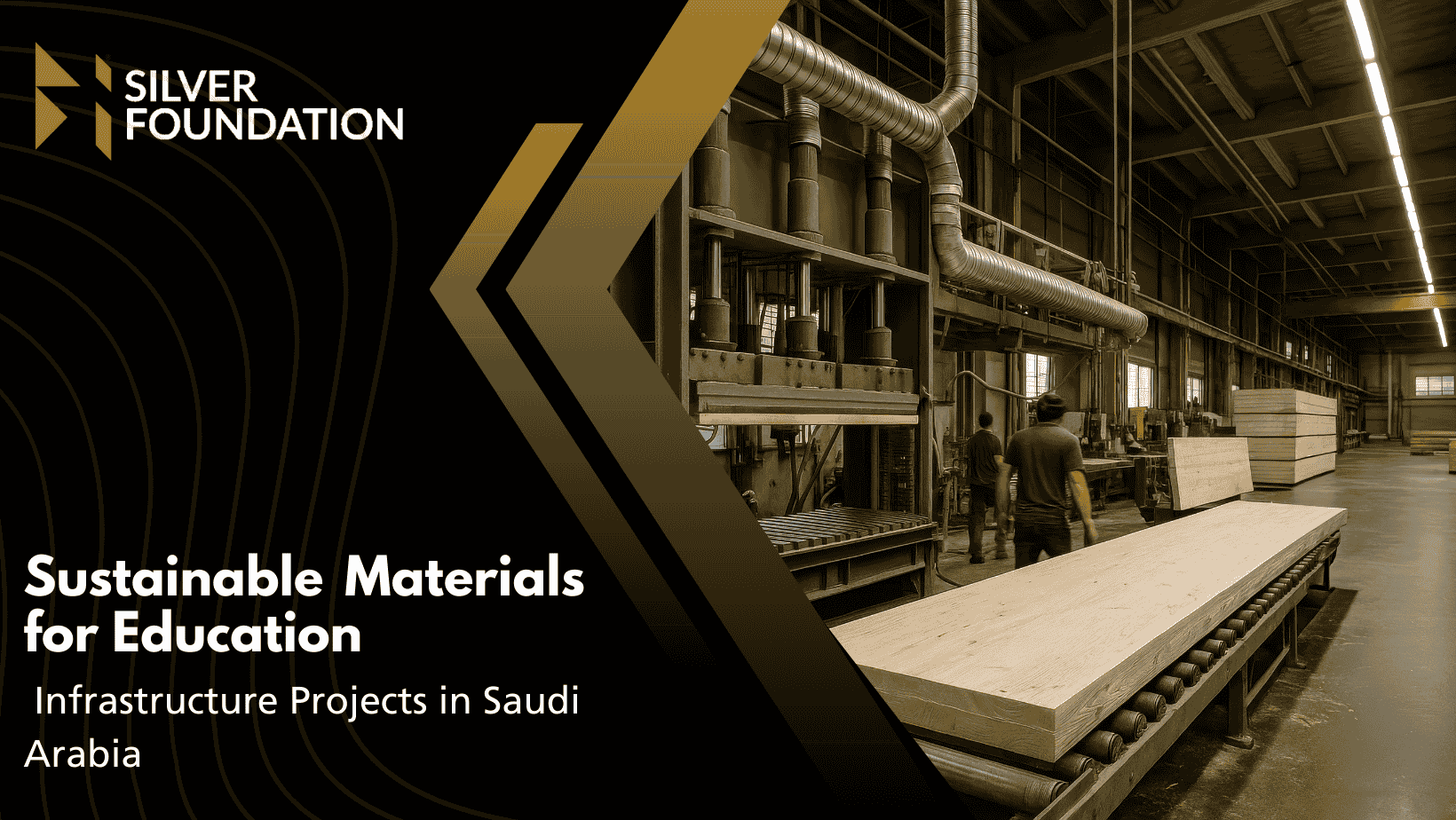
The bamboo and engineered wood are renewable, fast-growing materials that can be used in classrooms, libraries and auditoriums. They are strong structurally and are attractive and have a low carbon footprint when compared to steel and concrete. The materials improve the quality of indoor air and provide a natural, cozy environment to students. They are eco-friendly in terms of being renewed and versatile in the case of educating infrastructure in Saudi Arabia.
Recycled Steel and Aluminium
Recycled steel and aluminium are strong and rigid in response to severe climatic conditions. Through recycling of metals, the energy used in production is minimized, which reduces the effect on the environment. These materials are very popular in school structures and mass institutions of education, which guarantees durability and security. Their use promotes eco-friendly building programs. It also provides alternative high-performance and cost-effective building materials as opposed to conventional building materials.
Low-Emission Concrete
The low-emission concrete involves the use of fly ash or slag, or other binders, to minimize carbon dioxide emissions. It is highly strong and durable, and thus, it works well in the desert environment in Saudi Arabia. This form of concrete balances performance and environmental responsibility. When low-emission concrete is incorporated in learning institutions, the developers will ensure that the environmental impact is minimal. It still has strong and durable structures that can support students and staff members.
Insulated Panels and Green Roofing Materials
Polarized panels and green roofing substances offer thermal insulation to fight intense temperatures. They reduce the costs of operations in terms of the energy used to heat and largely cool the environment. Green roofs are also in favour of rooftop gardens, biodiversity, and help in controlling rainwater. These materials are used to produce comfortable learning environments. They are environmentally friendly and enhance the overall performance of the environment of a building.
Recycled Plastic Composites
Recycled plastic composites are resistant to moisture, light, and durable, thus suitable to use in furniture, the floor and the exterior facades. They encourage the practice of a circular economy through the recycling of waste plastics. These products provide cost-effective and eco-friendly savings, low-maintenance and eco-friendly solutions to learning institutions. Recycled plastics can be incorporated to achieve sustainability in building as well as to provide practical and aesthetics value to schools and universities.
Innovations Driving Sustainable Material Adoption
Recycled materials and 3D printing are used in education infrastructure at a massive rate because of new modern innovations. These innovations have made it easy to use recycled materials in education infrastructural designs. Prefabrication methods reduce on-site disturbance and wastage of materials. It also enhances the efficiency of construction. Probably, smart materials like energy-efficient glazing and adaptive insulation lessen the operational expenses and increase comfort.
Saudi Arabian case studies have shown how creative solutions can provide sustainable schools and universities without taking quality into consideration. These developments simplify the process of delivering to the architects, engineers and builders with the options to incorporate eco-friendly solutions. This will make educational spaces environmentally responsible and prepared to meet the challenges of the future. Scaling eco-friendly construction in the country is done through innovation.
Insights on Policy Frameworks and Standards
The policies and standards that Saudi Arabia has developed facilitate the use of sustainable construction of educational facilities. The Saudi Green Building Forum provides guidelines for the creation of energy-efficient and environmentally friendly projects. Such international certifications as LEED offer a standard in the eco-friendly design, construction and operation of schools and universities.
The government has introduced incentives to use environmentally friendly materials, and this is in favour of the involvement of the private sector. These policies not only control but also motivate innovation, which means there is a compliance and sustainability culture encouraged. By building according to international certification, schools can minimize their carbon footprint. They can enhance student welfare, the overall environmental and economic objectives of the Kingdom.
Basic Challenges and Solutions a Beginner Should Know
High Initial Costs of Sustainable Materials
Sustainable materials carry higher costs, being more expensive to install initially. Nevertheless, the long-term advantages of saving energy, organizational durability, and the minimization of maintenance costs are more important than the start-up costs. They are financial incentives, gradual implementation, and life-cycle cost analysis. Schools and universities can prove their financial benefits in the long run. This is why they can invest in environmentally friendly materials and balance the development of the infrastructure.
Limited Local Supply Chains
The supply of eco-friendly materials in the region might be scarce, and it needs to be imported, which increases expenses. This issue can be solved by establishing the local supply chains in collaboration with the manufacturers and promoting local production. This can be reinforced through government backing and investment in the eco-friendly material industry. This makes green material more available and more affordable to educational building projects in Saudi Arabia.
Knowledge Gaps in Sustainable Construction
The construction teams might not be well-versed in green design and construction methods. These gaps can be filled through training programs, workshops and certification courses. Cooperation with foreign professionals and knowledge-sharing platforms would make sure that the local teams embrace the best practices. Enhancing technical expertise will enable the architects, engineers, and builders to provide quality green education infrastructure in a confident and efficient manner.
Resistance to Change
The use of eco-friendly materials may take too long to adapt to traditional construction habits. Resistance can be overcome by creating awareness and case studies of successful projects. Stakeholders can be convinced by highlighting cost savings in the long run, environmental advantages and the creation of improved learning environments. Prospective projects and incremental implementation create trust in the idea of sustainability, slowly transforming the way the industry thinks about being greener.
Maintenance and Life-cycle Management
Certain materials that are sustainable demand specialized knowledge in their maintenance. It is possible to develop clear maintenance guidelines, train the staff at the facility, use smart monitoring technologies and make sure that the performance is optimized. Life-cycle planning against long-term enables the planning of repairs and replacement, and prevents pollution. With early implementation of maintenance strategies, schools and universities can take the best out of eco-friendly materials.
Future Trends in Sustainable Education Infrastructure
The tendencies of eco-friendly education infrastructure in the future are based on new materials and environmentally friendly design. New construction materials such as bioplastics, carbon algae composite, and carbon-absorbing concrete help to make the environment less harmful and ensure durability. Solar panels and passive cooling systems are two renewable energy solutions that are increasingly becoming part of schools to reduce carbon footprints and lower operational expenses.
Continuous monitoring and research are stressed so that infrastructure is efficient, adaptable, and resilient. Community involvement is also essential in determining sustainability, creating environmental awareness and promoting participation among students. These trends put together form sustainable and learning friendly educational spaces.
Conclusion
Embracing eco-friendly materials brings clear environmental, economic, and social benefits. Saudi Arabia is setting a benchmark for eco-friendly education infrastructure in the Middle East. Silver Foundation encourages policymakers, architects, and educators to adopt sustainable building solutions. This helps in creating resilient, efficient, and responsible learning environments for generations to come.
Frequently Asked Questions
Why are sustainable materials necessary in Saudi education projects?
Sustainable materials reduce environmental impact, save energy, lower maintenance costs, and create healthier learning environments for students.
Which sustainable materials are commonly used?
Bamboo, recycled steel, low-emission concrete, insulated panels, and recycled plastics are widely adopted in educational infrastructure projects.
Are sustainable materials cost-effective?
Though initial costs may be higher, sustainable materials reduce energy consumption, maintenance costs, and long-term environmental impact.
How does Saudi Arabia support sustainable construction?
Through regulations, incentives, and standards like LEED, Saudi authorities encourage eco-friendly building practices for schools and universities.