
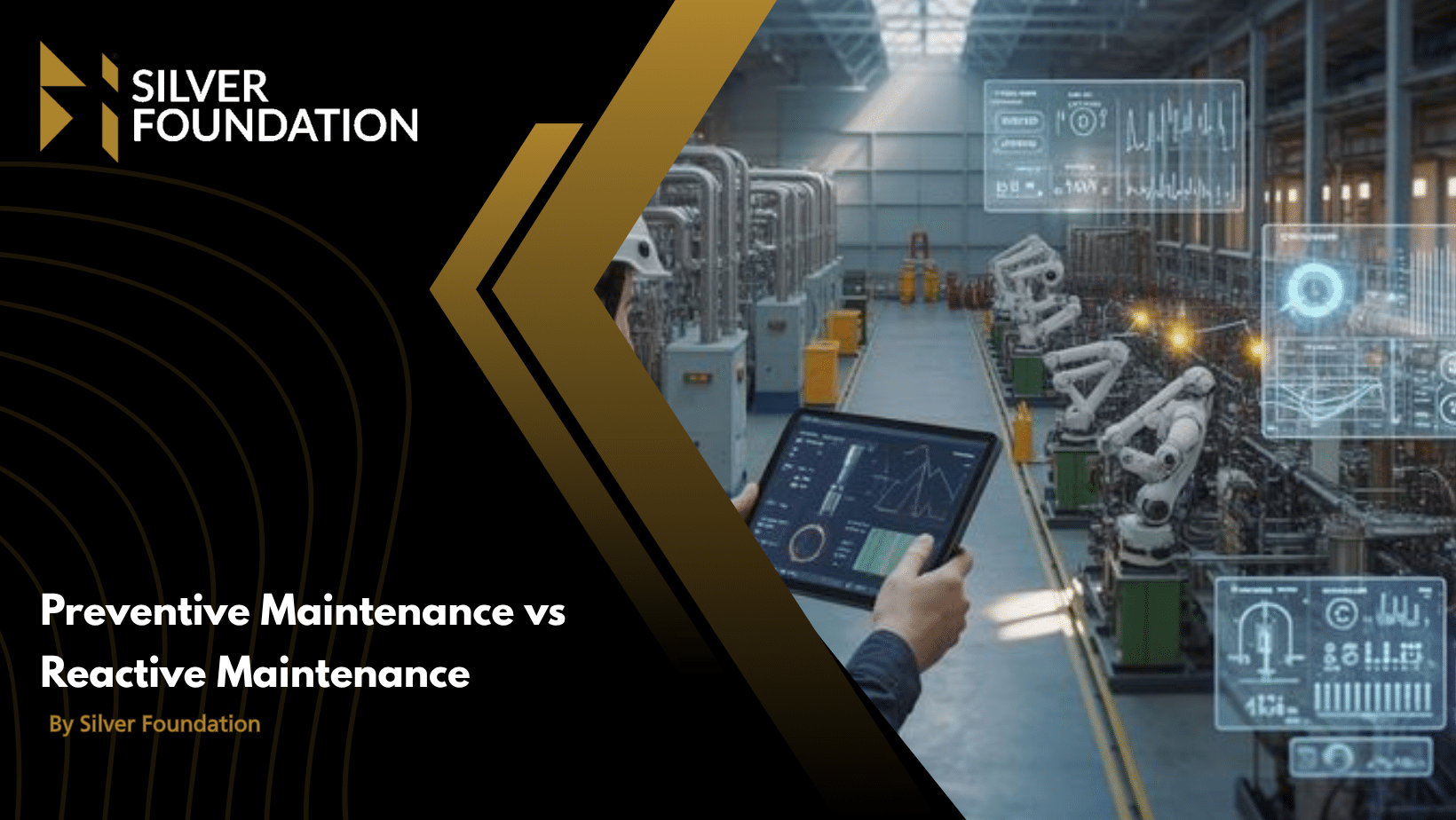
Preventive maintenance focuses on scheduled inspections, servicing, and repairs to identify potential equipment issues before they cause breakdowns. In contrast, reactive maintenance addresses problems only after failure occurs, often leading to downtime, urgent repairs, and unexpected costs. Understanding these approaches helps to choose an effective building maintenance strategy. Silver Foundation emphasizes reliable maintenance practices that can consistently support equipment performance, operational continuity, and long-term asset value.
There are two types of equipment and systems maintenance: preventive maintenance and reactive maintenance. Preventive maintenance is an inspection, service, cleaning, and replacement of parts in order to prevent a failure. It aims to minimize unplanned downtime and ensure that equipment operates efficiently.
In the case of reactive maintenance, it takes place when equipment fails or a noticeable problem occurs. Repairs are then made to put it back in normal working order. Preventive maintenance is primarily a planning and prevention approach, and reactive maintenance is a repair approach when problems emerge. Businesses commonly take both strategies, depending on the significance of the equipment, working conditions, expense of repair, and likely effect of unwanted downtime.
Key Benefits of Preventive Maintenance to Know
Reduces Unexpected Breakdowns
By performing routine maintenance, it’s possible to discover worn, defective, or broken parts before they cause the equipment to fail. Problems can be dealt with before they become serious with scheduled inspections and servicing. This can decrease unforeseen breakdowns, limit disruptions, and support companies in keeping smooth day-to-day operations without having to wait for significant gear issues.
Extends Equipment Life
The use of preventive maintenance will extend the service life of equipment. Unwanted wear and stress are minimized with cleaning, lubrication, inspections, and replacement of parts at the proper times. This means that machines can function with greater certainty and can serve a useful purpose for longer periods of time before they need to be fully replaced.
Improves Workplace Safety
If the equipment is not properly maintained, it can pose a hazard to workers and other activities. Preventive maintenance can identify problems like loose parts, electrical problems, leaks, or broken parts. Early resolution of these issues can lead to a safer working environment and to meeting workplace safety and maintenance requirements.
What are the advantages of Reactive Maintenance?
Lower Initial Maintenance Costs
Reactive maintenance doesn’t always involve the regular maintenance of all the equipment. To save some of the planned inspection and maintenance costs, the business can maintain the equipment only when it’s needed. This can be a practical option for basic and inexpensive equipment that doesn’t offer a great financial return if it’s maintained on a regular basis.
Simple Maintenance Approach
Reactive maintenance is simple, as action is taken when equipment has a problem or ceases operation. The need for detailed maintenance schedules for a particular asset is not so great. In some cases, it can simplify equipment management for companies that have less maintenance that can be done in-house.
Useful for Non-Critical Equipment
Equipment that has a minor effect on safety, production, or business operations may warrant a reactive maintenance solution. When replacement parts and repairs are inexpensive and easily obtained, and the failure of a low-priority machine is not as serious an issue as frequent preventive servicing, it may be more feasible to repair a machine once it fails.
Preventive vs Reactive Maintenance: Key Differences
Maintenance Timing
Preventive maintenance is carried out on a routine program or when equipment is ready for maintenance prior to failure. Reactive maintenance is initiated once there is an equipment failure or fault that is observed. The key distinction is that while preventive maintenance is designed to proactively solve potential issues, reactive maintenance is a form of maintenance that takes a reactive approach to addressing actual issues.
Cost Management
Preventive maintenance includes periodic costs for inspections, maintenance, labor, and replacement parts. These planned costs can help to cut down on costly emergency repairs and downtime, however. While the costs of routine maintenance may be lower, reactive maintenance can sometimes lead to more costly repairs, production losses, or emergency replacement costs when something fails.
Equipment Downtime
The main goal of preventive maintenance is to minimize downtime due to equipment failure by detecting and resolving issues in advance. Generally, maintenance can be performed at appropriate times. The risk of unexpected downtime during reactive maintenance is that repairs will have to be performed after a failure occurs, which could impact production, services, or other important business activities.
Equipment Reliability
Preventive maintenance can help maintain consistent equipment performance by ensuring the components are inspected, maintained, and adjusted regularly. Reactive maintenance relies on failure or malfunction to take any action, which means that often, it does not increase reliability until it is needed. So, the two methods are different in their approach to equipment reliability.
Planning and Scheduling
Maintenance schedules, maintenance records, inspections, and planned resources are required for preventive maintenance. Teams must be aware of the time for equipment maintenance and tasks to be performed. Reactive maintenance has a lower level of planning, and the maintenance is done when the equipment has issues, but teams need to have resources to perform the maintenance.
Suitable Applications
For critical equipment that failure might have safety implications, create a major loss or damage, preventive maintenance is often employed. For simple, inexpensive, or non-critical equipment, reactive maintenance may be appropriate. The right approach is dependent on the value of the equipment, the consequences if it fails, the operating environment it is used in, and the maintenance needs.
Preventive vs Reactive Maintenance: Comparison Table
Basis | Preventive Maintenance | Reactive Maintenance |
Meaning | Maintenance done before a problem occurs. | Maintenance done after a problem occurs. |
Purpose | Prevents equipment failure. | Fixes equipment after failure. |
Timing | Planned regularly. | Done when equipment breaks down. |
Cost | Usually lower and controlled. | Can be higher due to sudden repairs. |
Downtime | Reduces unexpected downtime. | May cause long unexpected downtime. |
Example | Changing oil regularly. | Repairing a machine after it stops. |
Planning | Easy to plan and schedule. | Difficult to plan. |
Equipment Life | Helps increase equipment life. | May reduce equipment life. |
Risk | Lower risk of sudden failure. | Higher risk of unexpected failure. |
Best Use | Suitable for important equipment. | Suitable for simple or low-cost equipment. |
Preventive vs Reactive Maintenance: Which is Effective?
Preventive or Reactive Maintenance is dependent on the equipment, operating environment, failure risk, and business needs. Preventive maintenance typically follows a pattern of routine checks and maintenance tasks, which can help companies avoid major issues. Reactive maintenance is about repairing equipment when it fails, and may work for low-risk or low-cost equipment.
There are many companies that take a mixture of both methods, instead of just one method. The critical equipment may be periodically preventively maintained, and the non-critical equipment may be repaired if it is necessary. The method should be determined based on downtime, safety, maintenance costs, equipment value, and the impact if it fails.
Conclusion
In conclusion, preventive maintenance reduces unexpected failures and long-term costs, while reactive maintenance addresses problems afterward. Companies like Silver Foundation can prioritize preventive strategies for reliability, efficiency, safety, and productivity.
Frequently Asked Questions
Does preventive maintenance reduce costs?
It can reduce the need for emergency repairs, downtime, and early replacements, but will need ongoing investment in scheduled repairs.
How often should preventive maintenance be performed?
Maintenance frequency depends on equipment type, usage, manufacturer guidance, environmental conditions, and the consequences of equipment failure.
Which systems require preventive maintenance?
HVAC, electrical, plumbing, fire safety, ventilation, elevators, and critical building systems commonly require scheduled maintenance and inspections.
Can preventive maintenance prevent all equipment failures?
None of the maintenance strategies will prevent all failures; however, frequent checks can detect many problems before they become severe.